The first 30 days of a new specialty food SKU define whether it succeeds or stalls. Here's the FoodSheet by LinkPaw playbook that importers and distributors use to hit their first-month placement targets.
A new product from your Italian importer just landed in the warehouse. It's a Sicilian wild fennel pollen — hand-harvested, zero domestic competition at this price point, and genuinely exceptional. Your importer is excited. You have 200 cases to move in the first quarter. Your sales manager has set a 30-location placement target for month one.
You have your accounts, your car, your phone, and about six weeks before the window closes and this becomes just another line item on a crowded import list.
What you do in the first 30 days determines whether this product becomes a hero SKU or a warehouse conversation. In specialty food, launches stall not because the product isn't good enough — they stall because the information doesn't get to the right buyers fast enough, in the right format, with the right follow-through.
Here is the FoodSheet by LinkPaw launch playbook that specialty food importers and distribution reps use to hit first-month targets.
── BEFORE DAY ONE: BUILD THE INFRASTRUCTURE ─────────────────────
The most common launch mistake: spending the first week of the launch window creating materials. By the time you've assembled the sell sheet, formatted the PDF, compiled the email list, and sent the blast, you've burned four days and your most attentive buyers have already moved past it in their inbox.
Build everything in LinkPaw before the launch date. That means four FoodSheet pages at foodsheet.linkpaw.com:
The Master Product Page
Complete and comprehensive: full producer story, origin region, harvesting or production method, certifications (organic, DOP, artisan designation), tasting notes, suggested applications, suggested retail pricing, wholesale case price, case configurations, and a direct booking link for sample requests. This is your definitive reference and the page you share with buyers who want the full story.
The Specialty Retail Page
Same product, story-first framing: producer narrative, high-resolution imagery, pairing recommendations, staff language, certification highlights, exclusivity or scarcity signals. Designed for the cheese shop owner, the artisan food boutique, the specialty grocery buyer who curates on taste and provenance.
The Food Service Page
Same product, kitchen-first framing: two to three recipe applications with technique notes, plate cost at wholesale pricing, consistency and availability information, food service pack sizes, staff tasting offer via Calendly. Designed for the chef and the restaurant purchasing manager.
The Launch Offer Page
If you're running a case deal or introductory pricing for the launch window, build a dedicated FoodSheet page in LinkPaw for it. Include the offer terms and an expiry date — use LinkPaw's countdown timer rather than just stating a date. A live timer creates genuine, visible urgency without requiring you to manufacture it artificially in your pitch.
Three hours to build all four pages before Day One. This is the foundation of your entire launch.
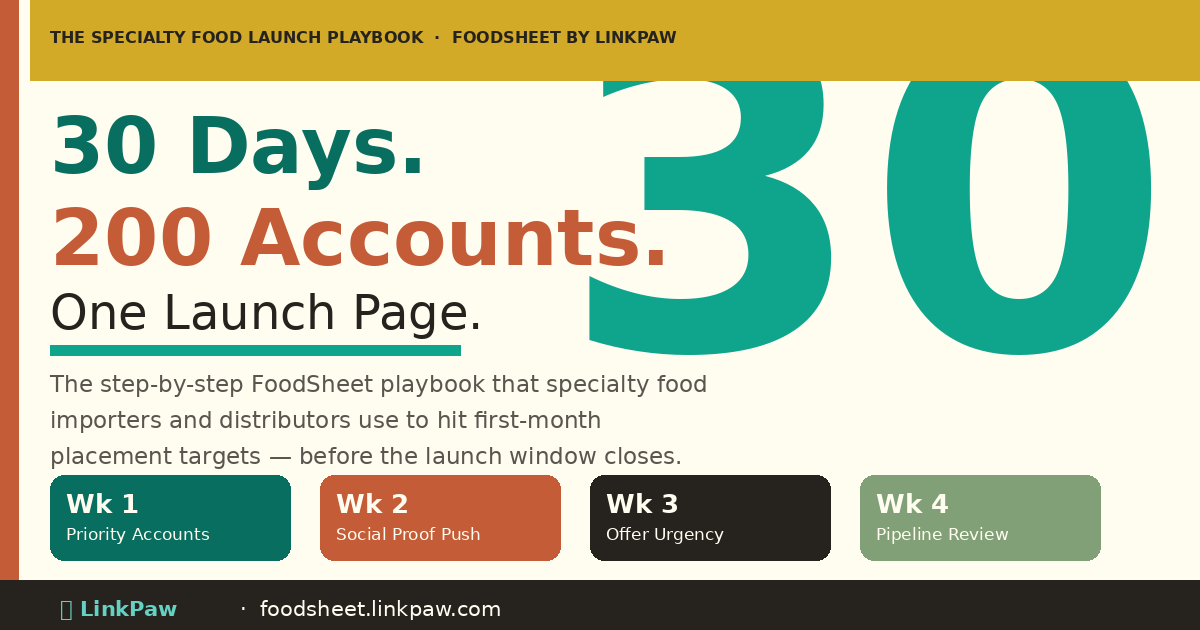
── WEEK ONE: PRIORITY ACCOUNTS ──────────────────────────────────
Your first seven days are for your ten to fifteen highest-value accounts — the buyers whose adoption creates the social proof and market credibility that every subsequent placement will lean on.
Two to three days before you visit each priority account, send them the appropriate FoodSheet page — specialty retail version for shops, food service version for chefs, master page for buyers who want the full picture. No ask attached. Just: "Heading your way next week — just landed something I think fits your program. Have a look when you get a moment."
The LinkPaw analytics dashboard will tell you who opened it before you arrive, and which section of the page they engaged with most. Use this to open the conversation. A chef who spent time on the recipe applications gets a cooking conversation. A specialty retailer who focused on the certifications gets a provenance conversation. You're not guessing what they care about — you have signal.
Bring samples. The FoodSheet page does the pre-sell. The sample closes it. For priority accounts, book the sample follow-up before you leave — use the Calendly link embedded in the LinkPaw page rather than trading messages afterward.
End of Week One target: eight to ten confirmed placements from priority accounts. These are your proof points for every conversation that follows.
── WEEK TWO: SOCIAL PROOF AND MOMENTUM ──────────────────────────
Days eight through fourteen are when the launch builds velocity. You have placements at marquee accounts. Now you use them.
Update the master FoodSheet page in LinkPaw with a social proof section: "Now available at [Specialty Shop A], [Restaurant B], [Grocery C] across the Pacific Northwest." This is not a brag. It is information that reduces the perceived risk for buyers who are still deciding. If the most respected Italian food shop in the market is stocking this product, that is signal. Make it visible.
Share the updated page with your next tier of accounts. The conversation is different now. "You've probably seen this at [Marquee Account] — we launched two weeks ago and placement has been strong. Here's the full story." Early-stage social proof is disproportionately effective in specialty food because buyers watch each other's choices closely.
Week Two is also when your food service push begins in earnest. Share the food service FoodSheet page with restaurant purchasing managers and executive chefs you haven't reached yet. The on-premise placements from Week One are now evidence of market traction — chef-to-chef credibility is some of the strongest social proof available in specialty food sales.
── WEEK THREE: OFFER URGENCY AND FENCE-SITTERS ──────────────────
Days fifteen through twenty-one are when the launch offer urgency peaks and fence-sitters make decisions.
The countdown timer on your launch offer FoodSheet page in LinkPaw is now showing single digits or fewer than two weeks. Buyers who received the page and engaged with it but haven't committed see the expiry clearly every time they open it. The urgency is visible, not manufactured by a sales rep claiming scarcity.
This week, focus your outreach on buyers who have opened your FoodSheet pages but haven't converted. You have the list in LinkPaw analytics. For each one, reach out with something specific — not a generic "just checking in," but a reference to the product they've been looking at and something useful. "I saw you were exploring the fennel pollen page — the chef at [Restaurant Name] just started using it in pasta and said it's the most versatile ingredient they've added this season. Happy to bring a sample."
This kind of outreach works because it's relevant. The buyer was already thinking about the product. You're giving them additional information, not additional pressure.
By the end of Week Three, you should be at or ahead of your 30-day placement target. The tail of Week Three and all of Week Four shifts from closing new placements to depth and documentation.
── WEEK FOUR: DEPTH, DOCUMENTATION, AND THE PIPELINE ───────────
Days twenty-two through thirty are for two things: converting the remaining interested accounts, and documenting the launch for your sales manager and the importer.
Keep sharing the FoodSheet pages. The launch offer may be closing, but the master product page at foodsheet.linkpaw.com is permanent. Every new account you share it with becomes part of your ongoing buyer audience — the next time you update the page with a new certification, a press mention, or seasonal availability news, they see it automatically without any action required from you.
At the end of Week Four, pull the LinkPaw analytics for the launch period. Total unique accounts reached across all FoodSheet pages. Engagement by page type — which version (retail, food service, master) generated the most conversions? Which products within the launch range got the most engagement? Which accounts opened pages but didn't convert — your pipeline for Month Two.
This data is your launch story. Not just "we placed at 32 locations" but "we reached 140 accounts, achieved 32 placements, and have a pipeline of 28 engaged accounts that haven't converted yet." That's a business narrative. It's also a compelling case for continued importer support, increased territory marketing budget, and a stronger position in your next portfolio review.
"I ran my last two launches on FoodSheet through LinkPaw from Day One. The second launch I hit my placement target in 19 days. The pipeline data I showed the importer after Month One led to them increasing my territory marketing support by 40 percent." — Specialty Food Distribution Rep, Mountain West Region
── WHAT MAKES SPECIALTY FOOD LAUNCHES DIFFERENT ─────────────────
Specialty food launches are different from mainstream CPG launches in one critical way: the buyer relationship is personal. The specialty retailer who stocks your Sicilian fennel pollen is doing so partly because they trust you and trust the story you've told them about the product. The chef who specs it into a dish is doing so because they believe in the quality and reliability of what you're bringing them.
That means the information you deliver — and the way you deliver it — carries relational weight. A sloppy PDF with outdated certifications and stale photography damages not just the product launch but your relationship with that buyer. A polished, current, responsive FoodSheet page on LinkPaw does the opposite: it signals that you take your products seriously, that you stay current, and that you're invested in the buyer's success with the product, not just in getting the initial order.
The launch playbook above is effective because it's systematic. But the reason it works in specialty food specifically is because the FoodSheet pages it's built on are good enough to represent the quality of the products they describe — and because the LinkPaw analytics tell you enough about buyer behavior to make every follow-up feel like a service rather than a sales call.
That combination — great product pages plus genuine buyer intelligence — is what turns a 30-day launch window into a long-term placement that holds.
Ready to run your next launch on FoodSheet? FoodSheet, powered by LinkPaw, is built for specialty food importers and distribution reps — live product pages with certifications, buyer engagement analytics, and launch offer countdowns that create real urgency. Build your launch at foodsheet.linkpaw.com or book a demo at calendly.com/fryd-linkpaw/30min.