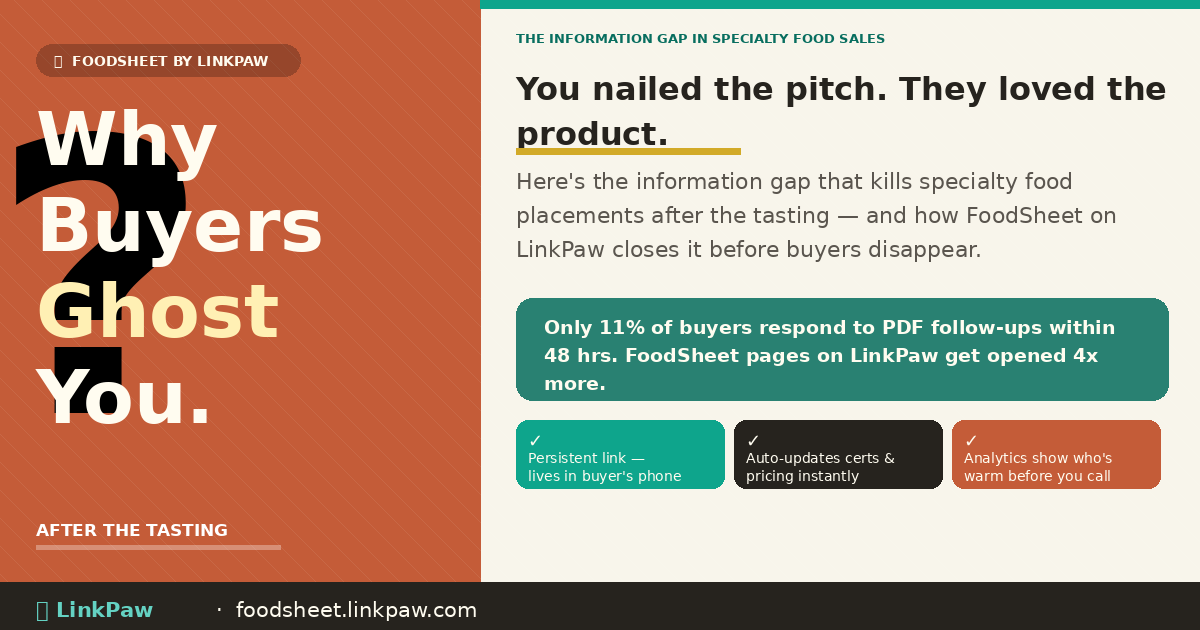
You nailed the pitch. They loved the product. Then: nothing. Here's the information gap that kills specialty food placements after the tasting — and how FoodSheet by LinkPaw closes it.
You did everything right. You got the meeting. You brought excellent samples. The buyer tasted everything, made enthusiastic noises about the truffle oil, said the preserved lemon was exactly what they'd been looking for, asked about pricing on the charcuterie board.
Then you emailed a follow-up. Then you emailed again. Then you called once, left a voicemail. That was three weeks ago.
If you work in specialty food sales, this is not a horror story. This is Tuesday.
The ghosting problem in specialty food sales is pervasive and deeply misunderstood. Most reps interpret it as buyer disinterest — the product didn't land as well as the meeting suggested, the buyer found something else, the timing was wrong. Sometimes that's true.
More often, the ghosting isn't about the product at all. It's about information. The buyer liked what they tasted. They just don't have what they need to take the next step — and the follow-up you sent them made the problem worse, not better.
── WHY THE POST-TASTING GHOST HAPPENS ───────────────────────────
Here's what actually happens after most specialty food tastings.
The buyer goes back to their office with good memories of the product and a PDF attached to your follow-up email. The PDF has your tasting notes, maybe some certifications, a price list. It's sitting in their inbox alongside forty-seven other things. They intend to look at it more carefully. They don't.
A week later, they want to revisit the truffle oil they liked. They can't find the PDF. They remember who you are but not the exact product specs. They meant to ask a colleague in purchasing about the category budget. They haven't. They're not ignoring you — they're just operating in a state of low-level information chaos that is the reality of most buyers' working lives.
Then your follow-up email arrives. It is, understandably, a version of "just checking in." It requires them to reconstruct the entire context of the tasting, find the original email, re-read the PDF, and then form a response. The cognitive cost of doing all of that is, at that moment, higher than whatever else is in front of them. They don't respond.
This is not buyer disinterest. This is information friction. And it is almost entirely solvable.
── WHAT THE BUYER ACTUALLY NEEDS AFTER THE TASTING ──────────────
The buyer who liked your truffle oil and then went quiet needs three things in order to act:
First, a persistent, findable reference point. Not a PDF buried in an email from three weeks ago — a link they can pull up on their phone at any moment that shows them the product exactly as it looked during the tasting. Specifications, certifications, provenance story, pricing. Everything in one place, accessible in two taps.
Second, updated information. Specialty food products change. Certifications get renewed. Seasonal availability opens and closes. New vintage information arrives. If the buyer goes back to a PDF from your tasting three months later, the information may be stale. If they go back to a live FoodSheet page on LinkPaw, the information is current — always. This matters more than most reps realize. A buyer who pulls up your page and sees a recently added certification or an updated trade price knows you're actively managing the product. It signals professionalism and reduces the perceived risk of the purchase decision.
Third, a frictionless next step. The buyer who's ready to move doesn't want to find your contact card, dial your number, wait for a callback, and then schedule a follow-up meeting. They want to tap a button and book time with you directly, or click a link and send a purchase request. Every step you remove between "interested" and "committed" dramatically increases your conversion rate.
A FoodSheet page on LinkPaw is designed to provide all three of these things. It's the persistent reference that lives in the buyer's browser history. It updates automatically. It includes a direct booking link via Calendly and a clear contact path.
── THE LINKPAW ANALYTICS ADVANTAGE: KNOWING WHO TO FOLLOW UP WITH ──
The other half of the ghosting problem is on the rep's side: not knowing which buyers are actually interested.
When you send a PDF to forty buyers after a trade tasting, you have no signal about who opened it, who read it, who forwarded it to a colleague, and who deleted it immediately. Your follow-up strategy has to be either universal — contact everyone — or based on memory and gut feel about who seemed most interested at the event.
Universal follow-up is volume sales. It's low-signal, high-effort, and tends to erode goodwill with buyers who weren't actually interested. Memory-based targeting is better but misses the buyers who seemed lukewarm at the event but went home and spent twenty minutes reading your product pages.
LinkPaw analytics changes this calculus entirely. When you share FoodSheet pages — at a tasting event via QR code, by text after a meeting, via email to a curated list — the LinkPaw dashboard shows you exactly who opened the page, how long they spent, and which products they engaged with most.
The buyer who seemed only mildly interested at the event but has now opened your olive oil page four times is not ghosting you. They're doing research. They're building a case internally. They're interested — they just haven't told you yet. Follow up with that buyer, reference the specific product they've been looking at, and the conversation will be different.
"Before LinkPaw, I was following up with everyone equally. Now I follow up with the people who are actually paying attention. My response rate went from about 12 percent to over 40 percent. The buyers I reach out to are already interested — I'm just giving them the nudge they needed." — Specialty Food Sales Rep, Northeast Territory
── THE FOLLOW-UP THAT DOESN'T FEEL LIKE A FOLLOW-UP ─────────────
The highest-converting post-tasting follow-up in specialty food sales is not "just checking in." It's a response to something the buyer has already done.
"I saw you were looking at the Calabrian chili paste — wanted to make sure you had the summer pricing before the case deal closes." This is not pushy. It's useful. The buyer was already thinking about the product. You're providing information they wanted.
"I noticed the team has been looking at the pasta range — I have some new production photos from the Abruzzo facility if you'd like me to add them to the page." This is service, not sales. It signals that you're paying attention and willing to add value.
Both of these follow-ups are only possible because FoodSheet, powered by LinkPaw, shows you who's engaging and with what. Without that data, you're sending the same "just checking in" email as everyone else — and getting the same silence back.
── BUILDING THE RIGHT POST-TASTING WORKFLOW ─────────────────────
The workflow that eliminates most ghosting looks like this:
Before the tasting: build the FoodSheet pages for every product you're featuring. Make sure they're complete — certifications, trade pricing, suggested retail, producer story, high-quality product photography. Include the Calendly booking link and your direct contact information.
During the tasting: have the QR code available. Not a business card — a QR code that links to your full FoodSheet portfolio at foodsheet.linkpaw.com. When a buyer expresses interest in a specific product, text them the individual product page link before they leave the table.
After the tasting (Day 1–2): check the LinkPaw analytics. Who has already returned to the portfolio? Who opened a specific product page more than once? Mark these buyers as warm leads and prioritize them for follow-up.
Follow-up (Day 3–5): reach out to warm leads with context. Reference the product they've been looking at. Offer something specific — a sample, updated pricing, an introduction to the producer. Make the follow-up useful, not perfunctory.
Ongoing: the FoodSheet page continues to work. Every update you make to a page — new certifications, seasonal availability, updated pricing — reaches every buyer who has ever received the link. The conversation never goes fully cold, because the page never goes fully dark.
Stop losing buyers to information friction. FoodSheet, powered by LinkPaw, gives specialty food reps live product pages, buyer engagement analytics, and automatic updates — everything you need to close the gap between a great tasting and a placement. Start at foodsheet.linkpaw.com.